


New article
Recently updated
Understanding CCO, CDO, minimum height and track violation rules

Who is this article for?Noise analysts who need a parameter reference for climb, descent, height and track violation rules.
Access to the ANOMS Noise Analyst Workbench is required.
This article provides a reference for CCO, CDO, minimum height and track violation rule parameters in the Violation Rules Manager.
Understanding CCO rules
CCO (Continuous Climb Operations) rules monitor departures for segments of level flight. The intent is to ensure a consistent climb to altitude, reducing noise disturbance on the ground.
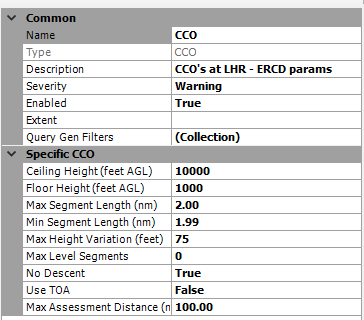
CCO rule parameters, including the ceiling and floor heights, segment lengths and maximum assessment distance
Parameter | Description |
Ceiling Height (feet AGL) | The top of the altitude band within which the system checks for level flight. |
Floor Height (feet AGL) | The bottom of the altitude band within which the system checks for level flight. |
Max Segment Length (nm) | The level distance a flight can fly before a violation is created. |
Min Segment Length (nm) | Works with Max Level Segments: if Max Level Segments is more than zero, a flight with more than one minimum-length segment that together add up to the max segment length also constitutes a full segment. If Max Level Segments is set to zero, this field is not relevant. |
Max Height Variation (feet) | A band: if the aircraft does not experience a height variation of more than this value, the flight segment is considered level. |
Max Level Segments | The number of shorter level segments allowed before they combine to count as a full segment (see Min Segment Length). |
No Descent | If set to true, a descent (rather than a climb) still counts as level flight. |
Use TOA | Use Top of Ascent: allows ANOMS to automatically determine when the operation levels out at cruising altitude and then stop checking for level segments. |
Max Assessment Distance (nm) | The system stops assessing for level segments once the operation is this distance from the airport. |
Understanding CDO rules
A CDO (Continuous Descent Operations) rule is the arrival mirror of a CCO rule: ANOMS analyses the arriving operation for portions of level flight instead of the departure. Continuous descent is desirable because level flight segments can result in increased noise disturbance on the ground as pilots increase throttle to maintain a level.
The parameters are set in the same panel and follow the CCO pattern. You define:
- The heights at which to start and stop checking
- The minimum length of level flight that constitutes a violation
- The altitude band in which the aircraft operates: if the aircraft descends out of this band, the level section has ceased
Understanding minimum height rules
The Min Height rule signals operations that drop below a specified height inside a preset radius around the airport. The radius can be based on either:
- Track length — the distance from the runway varies with the path actually flown
- The ARP — a fixed radius from the airport reference point
This selection matters for tracks with more turns: measured by track length, a turning track may appear closer to its limit than a track that approaches the airport in a straight line.
Understanding track rules
A Track rule uses existing airspace elements, departure or arrival corridors, to monitor compliance with the SIDs and STARs for the airport. Violations are created when the operation leaves the corridor in an undesirable direction. The pathname no longer has to match the corridor name for checking, as in many situations the operation may be assigned slightly different pathnames that essentially follow the same corridor.
Parameter | Description |
Min Time Spent in Violation | A grace period, in seconds (30, for example), allowing the pilot to correct if outside compliance. Keep this at zero if any deviation should become a violation. |
Passage Criteria | The corridor results that will not result in a violation, entered as letters (see below). |
The passage criteria letters are:
Letter | Meaning | Typical treatment |
B | Back — the operation exited through the last gate of the corridor. | Compliant at most airports. |
C | Ceiling — the operation exited through the ceiling of the corridor. | Compliant at most airports. |
N | No Intersection — the operation did not interact with the corridor at all (no entry, no exit). | Decide whether this is desirable for your airport. |
L | Left — the operation exited through the left side. | Usually undesirable. |
R | Right — the operation exited through the right side. | Usually undesirable. |
F | Floor — the operation exited through the floor. | Usually undesirable. |