


New article
Recently updated
Understanding flight corridors and corridor compliance

Who is this article for?Noise analysts and airport staff who want to understand corridor compliance monitoring.
Access to the ANOMS Noise Analyst Workbench is required.
A corridor is a series of gates, called corridor gates, linked together to create an imaginary tunnel that aircraft fly through, which ANOMS uses to check whether flights stay within prescribed noise abatement routes.
Understanding why corridors matter
Flight route analysis helps you understand the impact of aircraft noise on the community, and lets the airport noise office accurately determine the most important routes for noise abatement attention. Noise abatement policies can then be attuned to monitoring whether flight tracks stay within the prescribed corridor.
ANOMS detects flight tracks that did not comply with corridors automatically, so you can promptly generate reports listing all flights that strayed from their assigned corridors within a given period. Each violation is recorded with detailed information:
- Time of the corridor violation
- Violation type (corridor ceiling or floor, left or right side)
- Distance from the corridor centreline, aircraft altitude, and speed
- Flight operation details
This information is used to produce reports and graphical representations for working with pilots and airlines, helping ensure aircraft fly only along accepted noise abatement paths.
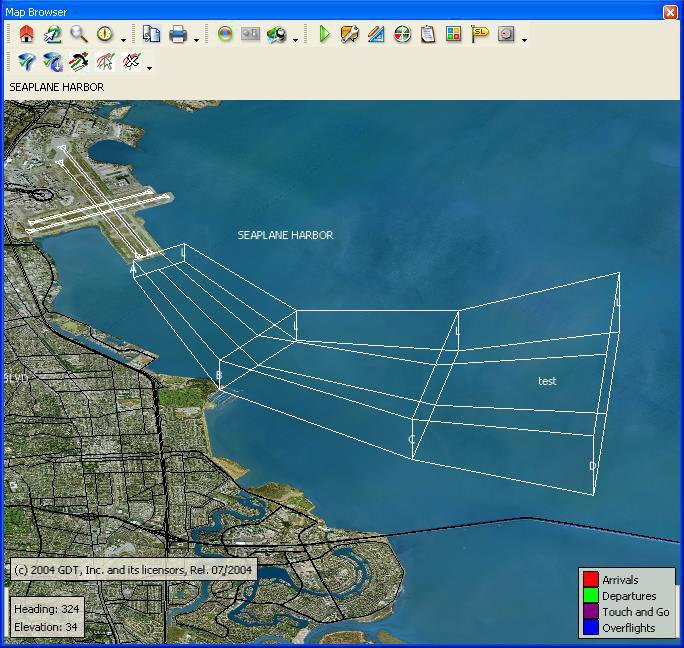
A corridor displayed on the Map Browser as a tunnel of linked gates
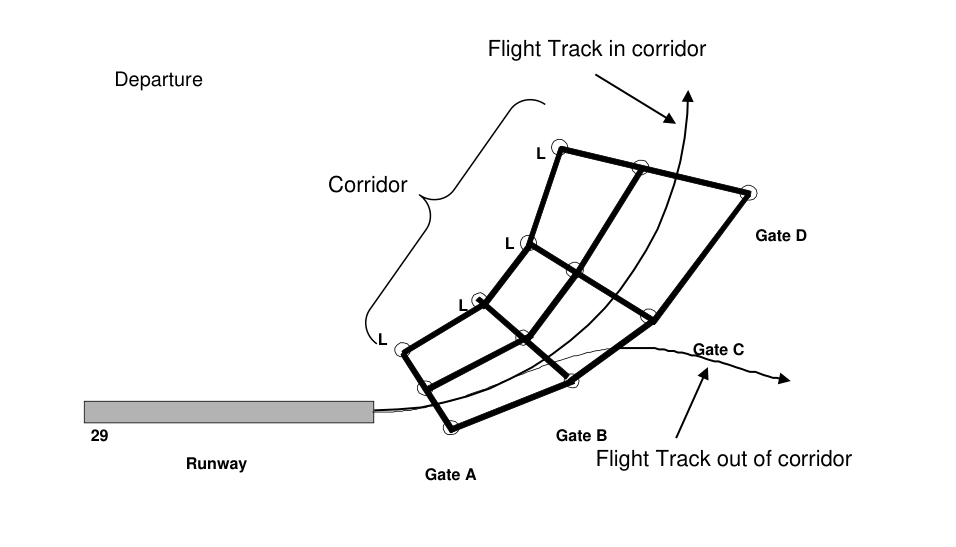
A departure corridor: linked corridor gates form a tunnel, with one flight track inside the corridor and one outside
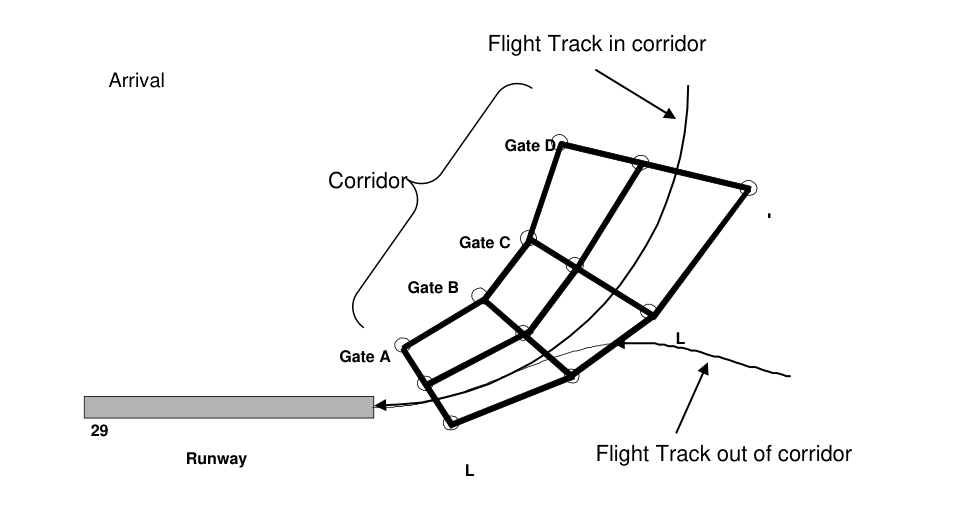
An arrival corridor, built from the start of the approach towards the runway
Understanding how violations are detected
To qualify for corridor analysis:
- The corridor must be active
- The flight track must pass through the first or last corridor gate in the corridor (this allows the corridor to capture violations for both arrivals and departures)
A corridor violation occurs if the track misses consecutive corridor gates. It is therefore important to have sufficient gates and to position them correctly.
Understanding corridor side codes
Operations that have been assigned corridors can be filtered most effectively by the Corridor Side criteria:
Code | Meaning |
T | Through — the operation passed through the corridor correctly (compliant) |
C | Ceiling — the operation violated the ceiling of the corridor |
F | Floor — the operation violated the floor of the corridor |
L | Left — the operation violated the left side of the corridor |
R | Right — the operation violated the right side of the corridor |
Using corridors
After corridors are created, they can be used to:
- View gates and corridors on the map display in 2D and 3D modes
- Produce Corridor Analysis reports
- Produce Corridor Violations reports